
Fedora aims to be a complete, general-purpose operating system built from open source software. Fedora is designed to be easily installed and configured with a simple graphical installer and the 'system-config' suite of configuration tools. The installation system includes an option to use GNU GRUB, a boot loader, facilitating the use of Fedora in conjunction with another operating system. Packages and their dependencies can be easily downloaded and installed with the yum utility. New releases of Fedora come out every six to eight months. Fedora can run GNOME or KDE, and spans 5 CDs or a single DVD. Network installations are available from a single small 6 MB boot.iso image. The installer supports installation via HTTP, FTP, and NFS, and remote installation progress can be monitored via VNC.
Fedora was derived from the original Red Hat Linux distribution. The project envisages that conventional Linux home users will use Fedora, and intends that it replace the consumer distributions of Red Hat Linux. Support for Fedora comes from the greater community (although Red Hat staff work on it, Red Hat does not provide official support for Fedora).
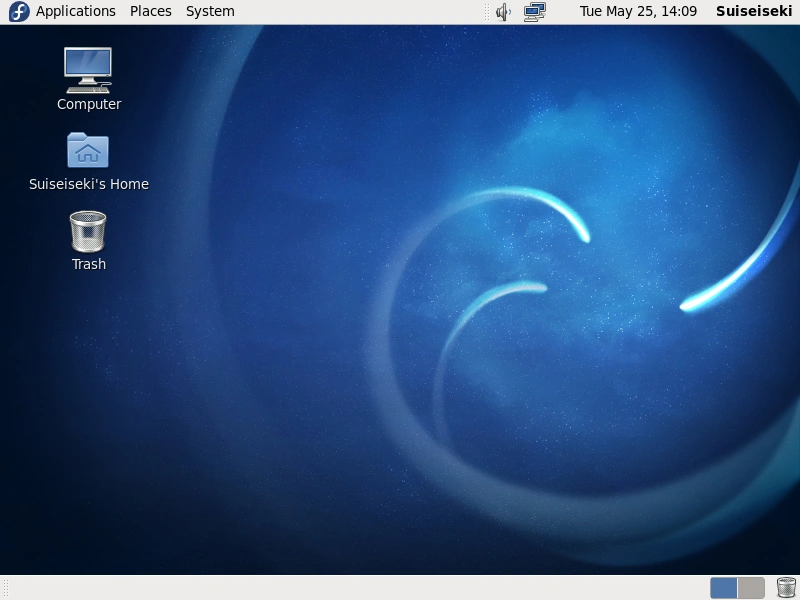

Fedora 13 with the GNOME desktop
Developer
- Fedora Project
License
- GNU GPL, and others
Languages
- Afrikaans, Akan, Albanian, Amharic, Arabic, Armenian, Assamese, Asturian, Azerbaijani, Balochi, Basque, Belarusian, Bengali, Bengali (Indian), Bosnian, Bulgarian, Burmese, Catalan (Valencian), Chinese (China), Chinese (Hong Kong), Chinese (Taiwan), Croatian, Czech, Danish, Dutch (Flemish), Dzongkha, English, English (South Africa), English (United Kingdom), English (United States), Esperanto, Estonian, Finnish, French, Friulian, Galician, Georgian, German, Greek, Gujarati, Haitian (Creole), Hebrew, Hindi, Hungarian, Icelandic, Iloko, Indonesian, Irish, Italian, Japanese, Kannada, Kashmiri, Kirgyz, Korean, Kurdish, Lao, Latin, Latvian, Lithuanian, Macedonian, Maithili, Malay, Malayalam, Maltese, Marathi, Mongolian, Nepali, Northern Sotho, Norwegian, Norwegian (Bokmål), Norwegian (Nynorsk), Oriya, Panjabi, Persian, Polish, Portuguese, Portuguese (Brazilian), Romanian, Russian, Serbian, Serbian (Latin), Sinhala, Slovak, Slovenian, Southern Sotho, Spanish (Castilian), Swahili, Swedish, Swiss German, Tagalog, Tajik, Tamil, Telugu, Thai, Tibetan, Turkish, Twi, Ukrainian, Urdu, Vietnamese, Welsh, Western Frisian, Wolof, Xhosa, Zulu
External links
Template:wikipedia